Showing posts with label Parables. Show all posts

Sunday, October 12, 2014

Party Attire

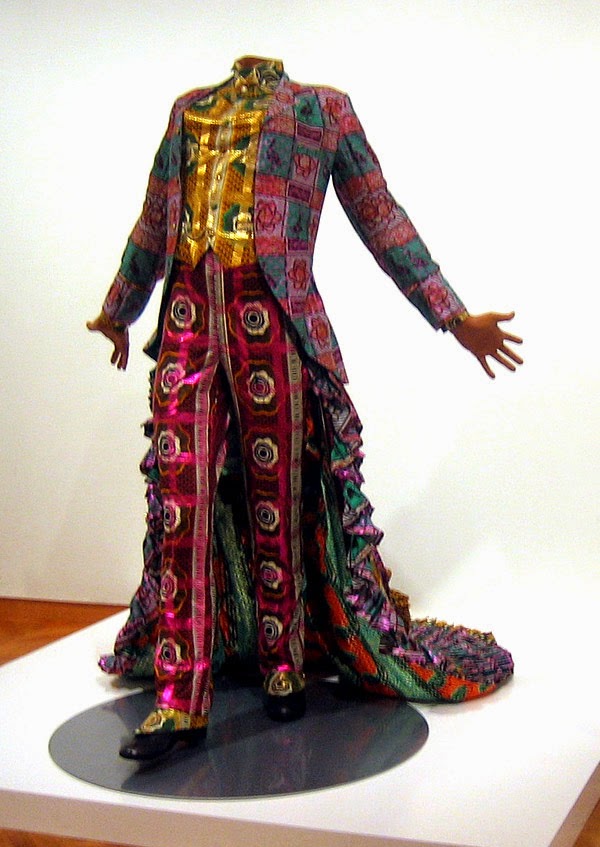
From the installation "Party Time: Re-imagine America". Yinka Shonibare MBE

Matthew 22:1-14

And Jesus answered and spoke to them again by parables and said: “The kingdom of heaven is like a certain king who arranged a marriage for his son,  and sent out his servants to call those who were invited to the wedding; and they were not willing to come. Again, he sent out other servants, saying, ‘Tell those who are invited, “See, I have prepared my dinner; my oxen and fatted cattle are killed, and all things are ready. Come to the wedding.”’ But they made light of it and went their ways, one to his own farm, another to his business. And the rest seized his servants, treated them spitefully, and killed them. But when the king heard about it, he was furious. And he sent out his armies, destroyed those murderers, and burned up their city. Then he said to his servants, ‘The wedding is ready, but those who were invited were not worthy. Therefore go into the highways, and as many as you find, invite to the wedding.’ So those servants went out into the highways and gathered together all whom they found, both bad and good. And the wedding hall was filled with guests. But when the king came in to see the guests, he saw a man there who did not have on a wedding garment. So he said to him, ‘Friend, how did you come in here without a wedding garment?’ And he was speechless. Then the king said to the servants, ‘Bind him hand and foot, take him away, and cast him into outer darkness; there will be weeping and gnashing of teeth.’

The end result of the contemporary art of Yinka Shonibare and the storytelling of Jesus Christ are identical: nice clothes and a big meal. They both weave narratives in diverse media that culminate with a scene whose focal points involve ornate costumes surrounding an elaborate banquet table. To understand how the two separately came to corresponding images independently one must understand the cultural context of both creators. Both freely reference their personal ethnic traditions but show the listener/viewer it's transcultural and transchronological implications. Both Jesus and Yinka were sharing timeless and global stories. Understanding the context of their nice clothes and big meal stories will also shed light on the meaning of all of their work.

How to Blow up Two Heads at Once (Ladies), Yinka Shonibare, MBE

The Artist

Yinka Shonibare is like many of the other successful artists of the YBA (Young British Artists) generation. He was born in London and received his MFA from Goldsmiths, University of London and has met astounding success being exhibited in the Venice Biennial, Smithsonian Institution, and being considered for a Turner Prize. Yet while a student one of his professors challenged the authenticity of his artwork. He asked Yinka why he wasn't creating "authentic African art." You see, Yinka was born in London but his parents were Nigerian immigrants and he spent portions of his childhood in the United Kingdom and Lagos, Nigeria. In contemporary times it may be understood as offensive for a non-Black professor to tell his Black student that his artwork isn't Black enough. Yinka's identity was not the one dimensional flat character that onlookers assumed it to be. He was Black but he was also Black British and the conception of identity worldwide was changing from something static to something dynamic. But this was the 80's and a young Yinka Shonibare humored his instructor. He went around town looking for "African" things to incorporate into his artwork. By 1994 he settled on the colorful Batik print clothing that is popular in Western Africa. By this point the colorful Batik prints were recognized worldwide by Black Africans, Black African immigrants in the West, Blacks from the African Diaspora and non-Black/non-Africans alike as the "African" look. Yet the history of Batik print was a little more intricate than the monolithic cultural notion that surrounds it. Batik is worn by Africans but it is not African itself. It is an Indonesian wax resist dye method that allows multiple colors to be printed on fabric. yet it was the Dutch who adopted this method and created the mass produced market in West Africa. Their factories in the Netherlands and Manchester, England churned out this print on American cotton (picked by Black American slaves from the African Diaspora) to clothe buyers in Nigeria. In this ornate global market Europe was creating the symbol of African identity. Yinka started creating scenes of Victorian opulence where the costumes (designed in the height of European historical fashion) are all created from Batik print cloth. These works comedically critiqued European and African notions of cultural, racial and national homogeneity. It also discussed colonialism, post-colonialism and the centuries old phenomenon of globalization. All of these cultural, historic and contemporary considerations are tied into the context of Yinka's nice clothes and big meal.

Three Graces, Yinka Shonibare, MBE

The Setting

Jesus' parable of the Wedding Banquet (known as a few other names) in Matthew 22:1-14 is similar to many of Jesus' other parables. The story is a sermon through narrative and symbols. The symbols refer to parties in Jesus' immediate first century context, yet they have lasting implications for following Christ in a contemporary setting. However mare than any other parable, Matthew 22:1-14 may have the most cultural considerations that need explanation to the reader. The details of wedding rituals in Jesus' day are key to understanding the symbols of Jesus' parable. First of all the marriage process had two parts, it is still the same today in traditional Jewish weddings. Wikipedia explains it this way:
"Technically, the Jewish wedding process has two distinct stages: kiddushin (sanctification or dedication, also called erusin, betrothal in Hebrew) and nissuin (marriage), when the couple start their life together. The first stage prohibits the woman to all other men, requiring a religious divorce (get) to dissolve, and the final stage permits the couple to each other. The ceremony that accomplishes nisuin is known as chuppah.
Today, erusin/kiddushin occurs when the groom gives the bride a ring or other object of value with the intent of creating a marriage. There are differing opinions as to which part of the ceremony constitutes nissuin/chuppah; they include standing under the canopy - itself called a chuppah - and being alone together in a room (yichud). While historically these two events could take place as much as a year apart, they are now commonly combined into one ceremony."
The last line is critical for our understanding of Jesus' parable: "historically these two events could take place as much as a year apart." So the community would become aware of the marriage long before what we understand as a "wedding ceremony" would take place. So like the parable, the guests would receive an invite long before the wedding and then be alerted again when the wedding was about to occur. Here's the kicker: nobody knew when the wedding would occur before hand and when they did, it would be immediate. Remember Jesus' parable of the Ten Virgins? It is based on the idea that they do not know when the bridegroom will arrive. He could show up at any time and they would have to be ready for the wedding to occur at any moment. This was the common practice. Not only were brides expected to be ready for a wedding at a moment's notice, so were the invited guests. So in Matthew 22:1-14, when the servants go out to announce the wedding the second time, it isn't an announcement of a wedding later on that year, later on that week or later on that day. The announcement was for a wedding that was happening now. The expectation was for the guests to drop everything and come now! So what was the guest to do who was in the middle of doing farm work or sleeping and had no formal attire on? Weddings in Jesus' time not only provided special clothing for the bride and the groom but also for each guest. It is like a fancy restaurant that requires that all male diners wear a jacket. For those who don't have a jacket, the restaurant provides one. The immediate cost of the banquet and clothing comes at great expense to the family that throws the wedding, therefore it is understandable that they would expect all invited parties to attend. Jesus' parable illustrating the kingdom of heaven as a wedding banquet then comes with the underlying themes of costliness, family and duty that all of his original listeners would understand. That is also the theme that belies the message to the present day reader. All of these cultural, historic and contemporary considerations are tied into the context of Jesus' nice clothes and big meal.


Big Boy, Yinka Shonibare MBE

The Story

The context of culture is key to gleaning meaning. So now that we understand the significance of fancy attire and elaborate feasts in the Anglo-Nigerian and Palestinian Jewish context, let's consider the meaning of them symbolically in Jesus' parable. It may not surprise you that the wedding of the King's Son is a reference to the marriage of Christ (the Son of God) to his people, the Church (known as the Bride of Christ). Throughout Scripture there have always been references to the relationship between Divinity and the Elect. God and Israel are often referred to as a married couple... often in a bad marriage. Yet the consummation of God's union with His people comes through His Son's self sacrificial ransom of them. And the People that the Son saves and takes as his bride is not only Israel, but the Elect among all the world. So when we see the servants announcing the Son's marriage in the beginning of the parable, it is an announcement of a kiddushin . It is the Prophets declaring that God's people have been betrothed or promised to Him. He has taken Israel to be His people and they take Him to be their God. This kiddushin is a sanctifying act. It testifies that there is yet a future date when God will ceremonially bind himself to the fullness of His people by revealing His fullness in the Messiah. So when the servants announce the wedding the second time, it is John the Baptist preaching that the wedding banquet/kingdom of God is at hand/now. Collectively these servants were rejected and killed. Those who murdered the prophets are punished by the destruction of their city (a less than veiled reference to the destruction of Jerusalem in AD 70 and all other previous destruction and diaspora by foreign invaders). Then the King asks the servants (the Apostles) to invite any and everybody to the wedding banquet. This is a reference to the admittance of Gentiles into God's people but also the poor, the sinful, the marginalized and anyone else whom the now judged religious leadership had failed to present the message of Mercy too. It is the open call of Grace. Yet the open call of Grace also comes with a covering of Grace. This is the wedding garment that the one wedding guest has neglected to wear. St. Augustine was the first expositor to point out that these garments were provided by the wedding party free of charge by the banquet host. He also saw the wedding clothes as symbolic of charity (works of unconditional love). Martin Luther agreed that the wedding garments had been provided for the guest but thought that the garment represented Christ himself (as our spiritual covering). John Calvin also had ideas about what the provision of the wedding clothes symbolized. In true Reformation fashion he focused it around the notion of faith and works:
"As to the wedding garment, is it faith, or is it a holy life? This is a useless controversy; for faith cannot be separated from good works, nor do good works proceed from any other source than from faith."
 I like to think that it is symbolic of the provision of holiness. Since Hebrews 12:14 says:
"Follow peace with all men, and holiness, without which no man shall see the Lord"
But then upon looking at the verse again, maybe it is holiness and peace with all men. Whether this covering is charity, faith, works, peace, holiness or Christ himself, I think that we can make the same conclusion. God has freely provided that which he requires. Ultimately the wedding garment is Grace, a free and unmerited gift. Those who have been invited to the banquet that is the kingdom of God have been given the Grace of charity, faith, works, peace, holiness and Christ himself to be covered in. All of the context of Grace is tied into God's nice clothes and big meal.


Scramble for Africa, Yinka Shonibare MBE
“For many are called, but few are chosen.”

The Royal invite

Politically Yinka Shonibare sees himself as a Republican. That is not to be confused with the American concept of a Republican as opposed to a Democrat in the United Sate's two party system. In the British context, a Republican is opposed to the Monarchy. A British Republican is an advocate of a Republic without the trappings (even ceremonial) of being governed by a Monarch. Yet Yinka Shonibare himself is part of the overall trappings of the British Monarchy. You may have noticed that on each image I have typed his name as "Yinka Shonibare MBE." The "MBE" stands for "Member of the Most Excellent Order of the British Empire". It is "the most junior and most populous order of chivalry in the British and other Commonwealth honours systems. It was established on 4 June 1917 by King George V," In 2004 Yinka was given this honor from the Queen for his service to the United Kingdom. The irony of receiving an honor from the empire was not lost on this Republican artist who critiques the evils of colonialism. yet in an interview Yinka shared that he was wooed by the grandeur of the monarchy whilst in the palace to receive honors from the monarch. Receiving a gift from a Monarch is hard to refuse. The conclusion of Jesus' parable ends with a notation about receiving a royal invite and gift: "For many are called, but few are chosen.” The parable of Matthew 22:1-14 centers around obedience to the King. The invite to the wedding is a command to attend. But solely focusing on this aspect will lead to the subtle overall truth behind the royal invite: it symbolizes friendship with the King. The guests have been given a gift by the Monarch. It is a very costly gift (for the King) that comes with a duty (for the guest). Yet all relationships (especially a friendship) come with those terms of gift and duty. Receiving a gift from a Monarch is hard to refuse, yet some do. That is the message of Jesus' story: Grace is free, Grace should be accepted, Grace is of ten rejected, Grace demands changes and Grace provides for that change. Many have been called t Grace, few responded, Some of those who verbally responded did not respond in their heart with change and therefore will not be chosen. The unstated ending of this parable is an invite. You have been called to dine with the King. What are you going to wear?


Dressing Down, Yinka Shonibare MBE


Tuesday, September 23, 2014

The Story of Two Brothers


Graves of Vincent and Theo van Gogh at the cemetery of Auvers-sur-Oise
Matthew 21:28-32

“But what do you think? A man had two sons, and he came to the first and said, ‘Son, go, work today in my vineyard.’ He answered and said, ‘I will not,’ but afterward he regretted it and went. Then he came to the second and said likewise. And he answered and said, ‘I go, sir,’ but he did not go. Which of the two did the will of his father?”
They said to Him, “The first.”
Jesus said to them, “Assuredly, I say to you that tax collectors and harlots enter the kingdom of God before you. For John came to you in the way of righteousness, and you did not believe him; but tax collectors and harlots believed him; and when you saw it, you did not afterward repent and believe him."

If you are a repeat reader of this blog then you have probably gathered that I write in the traditional five paragraph essay format (which is the same as a three point sermon structure). Even when I have more than five paragraphs, I still have five "sections." I start with an introductory paragraph, followed by three body paragraphs that illustrate different "points" and then I finish with a concluding paragraph. This week's post will be different. I will still use the five paragraph format but I will begin with the conclusion. By "conclusion" I not only mean the denouement of my argument about the biblical text, but also the conclusion that we all must come to in our lives: The grave. Actually there are two graves that I will discuss... and two lives. It should be noted that tombstones and grave markers are a type of art.  Rightfully so, since they are illustrations for a story. Tombstones picture the lives of those that lay six feet below them. They give us a glimpse into the deceased's biography, the legend that the community constructed around them or maybe even the fantasy that the departed would like you to believe. With only a shape, a name, a date and a sentence, the corpse communicates with you from beyond the grave. It strives to share its story. Maybe it's a cross shaped grave marker that reads "Shirley Grant, 1967-1996, Here lies a soldier, wife and mother of two." Or maybe it's like the graves pictured above, with only a "ici repose" (meaning "here lies"), followed by the deceased's name and lifespan. Since there is no is no story listed on these two graves, I will share it. They were the two brothers of the House of Van Gogh. One was named Vincent and the other was named Theo. One of these brothers is world famous. The other brother is only known because of his relationship to his famous brother. One of these brothers is known to history as a madman. The other one was a mild mannered businessman. One of these brothers was known to have a tumultuous relationship with a prostitute as his live-in girlfriend. The other brother was a married family man. These two brothers lived divergent lives yet both ended up in this same burial plot within six months of each other. There were also two brothers in the house of Jesus' parable. They also had stark differences between them. One brother was repentant. The other brother was self-righteous. Yet the underlying and unstated truth of Jesus' parable is that just like the Van Gogh brothers in the end they share a commonality. If you consider Jesus' parable in the overall context of Matthew 21 then you will find that the house of the two brothers in Jesus' parable is really about the House of Israel. It is a stinging indictment of the current state of God's House in first century Palestine. There were two brothers in the House of Israel. One brother was a symbol for the tax collectors and harlots. The second brother was a representation of the chief priests and the elders of the people. The commonality that these two brothers shared was that they were both sinners. Jesus shares how two people with the same problem (disobeying the Father) create divergent paths by dealing with it in starkly different ways.


Self-Portrait, Vincent van Gogh

 The First Brother

"Son, go, work today in my vineyard.’ He answered and said, ‘I will not,’ but afterward he regretted it and went. Then he came to the second and said likewise."

I have written about Vincent Van Gogh before on this blog. Vincent was many things in his life. He was a preacher and a missionary long before he was a painter. He was a bit too extreme in his ministry methods and was ushered out of that vocation. At this point he entered into the profession of painting as a second career and a spiritual vocation. However, I am not sure if we can fully call his painting a profession. He never was financially successful at it. All of these parts of his life were punctuated with erratic episodes brought on by his mental instability.  Van Gogh is as famous for his mental struggles as he is for his painting. Vincent Van Gogh's "constant" in life was inconsistency. Or was this his strength? Vincent van Gogh was given to change. The reason that we value his paintings was that he helped birth the post-impressionist era of expressionistic painting. He changed painting. Vincent was able to learn from historic European art, contemporary European art and fuse its painterly expression with the vibrant flat tonality of the East Asian prints that had come into fashion in his time. Vincent van Gogh was given to change and development and in doing so he changed Western Art. There is a value to those who are given to change. The Old Testament is full of stories of God choosing the inconsistent, wild and undeserving ones. God chose Jacob the liar over his brother Esau. He chose Joseph the dreamer over his other brothers. God also chose David the humble shepherd over his warrior brothers. In the New Testament Jesus continues this tradition by choosing the tax collectors, harlots and various other ragtag scalawags to be his followers. Why does God do this? Not because they were sinless. On the contrary, Jesus literally chose professional sinners. God chose this assortment of characters because their inconsistency showed that they were given to change. They changed from following their sin to following the Savior. If you are willing to allow God to change you, your past of sin does not matter.

Portrait of Theo van Gogh

The Second Brother

"Then he came to the second and said likewise. And he answered and said, ‘I go, sir,’ but he did not go." 

While Vincent Van Gogh was painting and starving in Arles, his brother Theo was running a successful business as an art dealer in Paris. Before this post he had previously worked in Brussels and London. All of this was accomplished before the age of thirty three. Theo excelled at business and family, while exercising prudent decision making at a young age. These are usually three factors that we praise an individual for. They are the criteria used to judge one as consistent. Yet, we don't celebrate Theo Van Gogh, do we? We celebrate the passion and ingenuity of his brother even though that greatness came with many a demon to wrestle with. It is very peculiar that the more stable brother is not the one that society champions. It is almost as if we punish him post-mortem because he was not given to change. Interestingly enough that is the same way that Jesus treats the second brother in the parable. The second brother showed no change... or as John the Baptist called it "repentance." The concept of repentance is simple as that: change. It is turning 180 degrees from sin and returning to God. The most important part of that last sentence was the "returning to God" part. God knows that we wrestle with sin...we are born into it. When one attempts to deal with sin outside of acknowledging their need for God they miss the big picture. Sin exists because we are absent from God's presence. The solution is to return to Him by following His Messiah that guides us back to Him. This missing element is the faith that the tax collectors and harlots possessed but the chief priests and the elders of the people lacked. The religious leadership of this time focused keenly on turning away from what they perceived as sin and uncleanness but failed to return to the God of mercy. Their turn was not 180 degrees but rather 360 degrees...which placed them right back at facing sin. Their greatest sin was a lack of mercy. Therefore they could not understand Jesus' ministry and message of mercy. Like the second brother, the chief priests and the elders of the people gave lip service to the Father (God) but did not do what he required. Entering the kingdom of heaven requires repentance. If you are not willing to allow God to change you, your past record of sacrifice and following the rules does not matter.

   Letter from Vincent van Gogh to his brother Theo, Etten, mid-September 1881

The Father's Will

"Which of the two did the will of his father?”

Heretofore I have left out a critical detail of the story of Vincent and Theo Van Gogh: their relationship was a good one. Theo Van Gogh was a loving brother to Vincent. He actually financially supported Vincent during his lean years. We have several letters of correspondence between the two, where Theo emotionally supports Vincent and encourages him in his painting. There are also other letters where Vincent takes opportunity to uplift Theo at points of loss and share his creative process. Some even say that Theo died so soon after the death of his older brother Vincent due to his grieving (that and the syphilis). These brothers were far from adversaries, rather they stood beside each other in life just as they lay next to each other in death. We know of their relationship because of their supportive communication to one another. We know of Theo's existence because of his love. There is no comparable support seen between the two brothers in Jesus' parable because the chief priests and the elders of the people gave no comparable support to the tax collectors and harlots. I am not sure if Theo served as Vincent's caretaker due to his father's request but I am certain that God the Father called the chief priests and the elders to be the spiritual caretakers of His people. Christ said that people will know his followers (God's children) by their love. The type of love that we see in the life of Theo van Gogh. The chief priests and the elders were supposed to care for the tax collectors and harlots and call them out of sin through acts of love. They were God's children too and therefore the chief priests and the elders' brothers and sisters. What was the will of the father in the parable? The will that He calls both brothers to? It was to work in his vineyard. It was to care for his creation. It was to tend to his flock. It was to love his people. The religious leadership of Jesus' day was called to be the caretakers of all of God's people, but Jesus' shows that their leadership is lacking. The chief priests and the elders would not repent for their lack of love as John the Baptist had demanded. Therefore they only gave lip service to the Father's commands. You cannot fulfill God's commands or abstain from sin if you do not practice love. The fullness of God's commandments is that we love one another.

Red Vineyards near Arles, Vincent van Gogh

Working the Vineyard Together

"For John came to you in the way of righteousness, and you did not believe him; but tax collectors and harlots believed him; and when you saw it, you did not afterward repent and believe him"

It is said that Red Vineyards near Arles was the only painting that Vincent van Gogh sold during his lifetime. The only financial success that this great painter met was while painting workers doing the same activity that the Father in Jesus' parable calls his sons to do. The Father has a vision of the beauty of cooperative labor for his sons. It is a beauty that the master Dutch painter captures and crystalizes two millennia later. The Father in this story (who happens to be our heavenly Father) has two sons that are both sinners. The difference between them is that one of them is honest and repentant and the other is self-righteous and repugnant. Only one of the brothers cooperated with the Father. The brothers' kinship in being sinners also reveals a common salvation to be had in Jesus and a common belief that they are called to possess in the preaching of John the Baptist. John the Baptist and Jesus Christ both shared a central theme to their message: the kingdom of God. John foretold of the coming kingdom of God and it's Messiah. Jesus is the Messiah and established the kingdom of God on earth. This coordination between their messages is not a coincidence but a precept of the kingdom of God. It is the call to cooperation. It is the call that the chief priests and the elders failed to exercise in their relationship with the tax collectors and harlots. They could not fulfill the call because there was no relationship between them. Herein lies the scandal that Jesus was to the religious leaders of his time: he ate and shared friendship with publicans and sinners. Jesus partnered with these sinners to change them. In the end that is what repentance is. We turn from sin and turn to God and form a partnership with Him. We cooperate with God for the changing of our lives and the changing of other lives. God calls us to create beauty with Him. It is a picture of Vincent Van Gogh and Theo Van Gogh. One brother was an artist. The other brother was an art dealer. They worked together to support each other. A partnership to create and distribute the art that changed the Western Art history forever. These two brothers created beauty. This beauty occurred because of the cooperation between change and love. That is the cooperation that God calls us to make with others. That is the partnership that God is making with Mankind. That is the story that God is telling. It is not a story chiseled on a tombstone but the story that creates everlasting life.

Sunday, May 11, 2014

Framing Sheep

Away from the Flock, Damien Hirst

John 10:1-10


“Most assuredly, I say to you, he who does not enter the sheepfold by the door, but climbs up some other way, the same is a thief and a robber. But he who enters by the door is the shepherd of the sheep. To him the doorkeeper opens

When we look at or imagine sheep, we see more than sheep. We see sweaters in the making. We see counting devices that act as sleeping aids. We see dinner. We see cuddly creatures that should be cartoonized and turned into stuffed animal dolls for children. When I look at a sheep I see someone with the same hair texture as me. We project every image onto the animal except that of the animal. Scripture is no different in it's treatment of sheep. Sheep are used as a symbol of humility, obedience, innocence, etc. In today's scripture reading Jesus used sheep as a metaphor.The contemporary artist Damien Hirst used real sheep...not a painting of a sheep, not a sculpture nor a performance piece about the idea of a sheep but an actual dead sheep. Yet he even found a metaphor in it for the human experience, stating that it was like "“that failure of trying so hard to do something that you destroy the thing that you’re trying to preserve.” In an interview with Mirta D’Argenzio he revealed that "the title came after Hirst completed the work and observed the 'tragic beauty' of the animal. The lamb, identifiable within Christian iconography as Jesus, has been separated by death from the living so that, 'you kind of feel sorry for it.'” Christian imagery has long used the image of a sheep for Jesus, echoing the "Lamb of God" image presented in the New Testament. However, in this scripture reading Jesus isn't referring to himself as the sheep but to us as the sheep.


Away from the Flock, Damien Hirst

Preserving Sheep

When Damien Hirst first displayed this piece (and others like it), he and his fellow YBA's (Young British Artists) were catapulted to fame. This artwork was bold, confrontational and controversial. Yet one cannot argue that what he was doing was new. He was preserving a dead animal in formaldehyde. Taxidermists and high school biology students have been doing some variation of this for generations. But Damien Hirst took preserving a sheep and made it Art. Hirst use of the formaldehyde barrier protected the dead sheep from being exposed to decay. Jesus opens up his parabolic metaphor by making obvious statements that everyone would agree with then using that common ground to make a deeper assertion. They all center around the argument that the best way to protect precious possessions is to put it in a protective barrier. Everyone would agree with this because everyone does this. To the Ming Dynasty of China it's precious possessions to protect was it's people. So it reinforced and completed a series of walls to protect them against Mongol invaders. We now know it as the Great Wall of China. In the Wild West frontier era of the United States cattle rustlers were a constant threat to rancher's primary investments. Then Joseph Glidden invented barbed wire as a way to protect and contain livestock. To the ancient Palestinian Jews that Jesus spoke to sheepfold or an encircling wall was the best way to protect your sheep. The key to any if these barriers is to channel entrance to one guarded point. The guard at this portal decides who is safe to enter and who is a threat to keep at bay. Anyone who hops the gate, scales the wall or cuts into the fence at any other place does it because they have malicious intent. They are barbarians hoards, outlaw rustlers, thieves and robbers who either desire to harm the sheep or the owner of the sheepfold (by stealing the sheep). Everyone of Jesus' listeners understood this. As observant Jews they probably also caught his veiled references to Psalm 23. They understood that they (Israel) were the sheep and that the Lord was their shepherd. What some of them didn't understand was that Jesus was saying that the thieves and robbers were the Pharisees, Jesus was accusing them of being the agents of death and decay that he was sealing the sheep against. The doorkeeper would not open to them for he knew that to let them beyond the protective barrier would expose the sheep to spiritual decay.


Away from the Flock (Divided), Damien Hirst

Dissecting Sheep

and the sheep hear his voice; and he calls his own sheep by name and leads them out. And when he brings out his own sheep, he goes before them; and the sheep follow him, for they know his voice. Yet they will by no means follow a stranger, but will flee from him, for they do not know the voice of strangers.”


Putting dead animals encased in formaldehyde was not a one time affair for Damien Hirst. Nor was displaying a sheep in this manner. A year later he would do another version of "Away from the Flock", but he would dissect this one in two. He actually called it "Away from the Flock (Divided)", "dissecting" is more of my word. Dissection denotes not only dividing something into parts, but rather dividing it into parts to better understand it. That is why we call Bible study/biblical exegesis "dissecting the scripture." When we dissect this part of the scripture we find that it dissects the nature of the sheep (the Christian). The first thing that we come to understand about the Christian and sheep comparison is that it is based on the sheep's listening skills. Apparently they are keen and Middle Eastern shepherding techniques are all based on them. Sheep can actually distinguish the voice of their shepherd from other voices. So they really won't follow others. This analogy was so tight that now you can understand why the Pharisees didn't follow where he was going with the illustration. It just appeared that he was just sharing shepherding instructions. When we dissect the analogy a Christian should have similar auditory capabilities. Hence we refer to the elect/people that God has chosen as "the called." Christians are not just the spiritually hungry and curious but those who (through the aid of the Holy Spirit) have recognized Jesus' voice amongst the cacophony of other voices claiming to be Truth. In recognizing Jesus as God they set out not only to be a "believer" but a "follower." That is the second quality that we share with sheep. Faith without deeds (of following) is dead. So by dissecting the sheep/Christian we not only makeup of sheep but also the potential behavior of the sheep. A sheep cannot do what it was not designed to do (like fly) and a person cannot do what the Holy Spirit has not called them to do (like have faith and works that glorify God). So the question begs: if sheep can recognize their shepherd how can Christians recognize the voice of God? Like with most parables, Jesus will eventually make it clear.


Away from the Flock (Divided), Damien Hirst

Encasing Sheep

Jesus used this illustration, but they did not understand the things which He spoke to them. Then Jesus said to them again, “Most assuredly, I say to you, I am the door of the sheep. All who ever came before Me are thieves and robbers, but the sheep did not hear them. I am the door. If anyone enters by Me, he will be saved, and will go in and out and find pasture. The thief does not come except to steal, and to kill, and to destroy. I have come that they may have life, and that they may have it more abundantly.

So what did Damien Hirst do that made his work artwork? Butchers have split sheep in parts for the ages. Students and taxidermists have suspended innumerable animals in formaldehyde. In fact it was probably one of them who did it for Damien Hirst because he is notorious for employing others to do his work for him. Well Damien Hirst is the one who encased it in a frame and put it in a gallery. In short he made it Art because he appreciated it as Art and made others see it as Art. In fact he had this to say of it “It’s not a ‘preserved’ lamb, it’s a dead lamb. But then it does have a kind of new life.” It is the framing in a casing of a gallery setting that gave it its new life as Art. So what did Jesus do that made his ministry different from the Pharisees? They were rabbis who taught about Scripture and were followed by disciples as well. Yet Jesus accused them (explicitly this time) of having come to steal, and to kill, and to destroy. Like with Damien Hirst, it is in the encasing of the sheep that the new life is found. You may have gathered by now that Jesus is the "good shepherd" in this parable but have you also come to realize that he is the one that constructs the sheepfold and gives it its formaldehyde-like powers to preserve you from death and usher you into new life? At this point in the parable Christ pulls no punches and says directly "I am the door of the sheep(fold)." Middle Eastern shepherds had a practice of standing in front of the opening to the sheepfold like a Samoan bouncer guarding the entrance into an exclusive night club. When they got tired they would sit in front of it. At night they would sleep in front of it. They were the only entry point and they decided who would and would not get beyond the velvet rope. The key to protecting the sheep is encasing them in exclusivity. That is not to inflate the ego of Christians but just to illustrate how valued they are by God. Platinum was just another really strong metal until someone valued it as jewelry. It may just look like dark silver to others but it is even more precious to the owner. Since we are that precious to Jesus, he shares the benefit of the sheepfold: life, and abundant life.


Away from the Flock (Divided), Damien Hirst

So that is what is behind Jesus' usage of sheep in this parable. It is also what separates Jesus from Damien Hirst and the Pharisees. The more I think about it Damien Hirst's artwork is a better illustration of the Pharisees' followers than Jesus'. Therefore the title of "Away from the Flock" is befitting. It is what happens when a sheep is drawn away from the sheepfold by one who has climbed up some other way rather than entered by the door. Yes the sheep may be look preserved but as Damien Hirst has pointed out it is still dead. Christ didn't come to beautify dead sheep and make them lifelike like Lenin "lying in state." Christ came to give you actual and full life. Yes I am talking about the afterlife but I am also speaking of the here and now. To often we live with the evidence of spiritual death lingering over us. That is the most that the Pharisees could promise their disciples: a reminder of their constant struggle with sin and God's judgment. I am not fully disparaging this because it is a necessary first step, however their is a second one too. This second step is not only a "freedom from" but also a "freedom to." It is a freedom from death and sin but it is a freedom to live, love and experience the fullness of what God has created you to be. That is the promise of the Good shepherd. Come back to the flock.


Sunday, October 13, 2013

The Dinner Party

The Dinner Party, Judy Chicago

Luke 14:1 & 7-14 

 
One Sabbath, when Jesus went to eat in the house of a prominent Pharisee, he was being carefully watched.
When he noticed how the guests picked the places of honor at the table, he told them this parable: “When someone invites you to a wedding feast, do not take the place of honor, for a person more distinguished than you may have been invited. If so, the host who invited both of you will come and say to you, ‘Give this person your seat.’ Then, humiliated, you will have to take the least important place. But when you are invited, take the lowest place, so that when your host comes, he will say to you, ‘Friend, move up to a better place.’ Then you will be honored in the presence of all the other guests. For all those who exalt themselves will be humbled, and those who humble themselves will be exalted.” Then Jesus said to his host, “When you give a luncheon or dinner, do not invite your friends, your brothers or sisters, your relatives, or your rich neighbors; if you do, they may invite you back and so you will be repaid. But when you give a banquet, invite the poor, the crippled, the lame, the blind, and you will be blessed. Although they cannot repay you, you will be repaid at the resurrection of the righteous.”
 
I have walked in the shoes of Martha Stewart and Julia Child. Don't worry, I'm not turning this blog into a Julie and Julia type blog. Last night my wife and I held our first dinner party. We have had a friend over for a meal before (on several occasions) but this one was more intentional. The previous weekend my best friend from high school ended up staying for dinner, so yesterday's dinner party was two of her friends from high school (and one spouse). We woke up Saturday morning and started cleaning, even though dinner was at 7:00 pm. Well mostly, I just attempted to look like I was cleaning when my wife was watching, then I'd go back to painting. Then by mid day I went to the grocery store to pick up a few things for dinner (sodas, cake... you know, the priorities). So when I came back my wife went to the grocery store because apparently people eat more than soda and cake nowadays (weird, right?). When she came back we finished organizing the place, cleaning up and finishing dinner. Actually when they arrived my wife was still blending a sweet potato soufflĂ© and I showed them around he place. Why did we go through all of this trouble? She has been friends with these people for about 16 years and I've known them for at least 3-4 years. It is because we wanted to feel comfortable and accepted. They may have been our guests for a few hours but we wanted them to feel "at home." You know that whole "Mi casa es su casa" thing that you are supposed to say with a "wink and a gun." Today's verses from the Gospel of Luke are about those very same considerations. Christ was invited to dinner, but it makes us wonder who he invites to dine with him. Who does Christ prepare a place for at his table? Who does he welcome into his Father's house and asks that they accept it as their own home?
 
The Dinner Party, Judy Chicago
For all those who exalt themselves will be humbled, and those who humble themselves will be exalted
 
I'm a McDonald's type cat. My mom cooked at home for most of our meals and my dad cooked a few times as well. But McDonald's was probably 25 % of the meals that I consumed. I learned to cook a little while living in the dorms at college, but I still kept a place in my heart for driving around and eating fries. And riding on the bus and eating tacos. And walking down the street eating a burger. And, well you get the idea... I like moving around and eating food that will lead to my demise. This being the case I never really learned the intricacies of dinning etiquette. Now keep in mind, I am not a total Philistine: I know the basics of eating a meal around non-barbaric company. But I never learned which side silverware goes on... and for some reason I can never commit it to memory. So if you are a stickler about dining and you are eating with me, then chances are you may be secretly judging me. In Luke 14 we find Christ observing the dinner etiquette of his dinner hosts. Jesus wasn't critiquing their table manners (remember he didn't scold his disciples for not washing their hands before meals, as was the Kosher custom) but rather the manner in which they lived. After noticing all of the schmoozing and jockeying for position that was occurring at this dinner table, Christ saw an opportunity to reveal how a simple setting like this displays one's internal spiritual condition. One should live life in a manner that displays humility. This is that type of life that God honors and the type of person that God rewards. God's mercy is always offered to the humble and not to the proud. All of Christ's Beatitudes of Matthew 5 can be summed up as "blessed are the humble." When we daily aspire to dine with the Breakfast of Champions God jut wants those to honor at his Dinner for Scmucks. True greatness is recognized by God. A God who esteems the lowly.
 
But when you give a banquet, invite the poor, the crippled, the lame, the blind, and you will be blessed.
 
So if we are to be like God and emulate His practices, then our dinner guests that we surround ourselves with should be similar to those that God surrounds himself with. Who do you break bread with? Do you make friends in an aspiration to "network" and benefit yourself or do you show love with the intention to serve? Give to those who have nothing to give and your Father will give to you. This emulates what God does... giving to those who have nothing to give. That is what Grace is. All of God's relationship with us is based on dependency: hence He calls us His children. When was the last time that a child returned something valuable to you in gratitude? I'm sorry, macaroni necklaces and refrigerator drawings don't count. Or do they? They have no financial value on the market, but they are true riches to a parent because they display the love that a child has for her parent. That's what God gets from us. True worship is gratitude and love. God may be rich in all of the wonders of the universe, but His greatest treasures appear to be the macaroni necklaces and refrigerator drawings that we give Him through prayer and our love for others. This being the case, Christ asks that we make room at our tables and our hearts for those who need. For there was once a time when we were spiritually and physically hungry and he did not turn us away.
 
The Dinner Party, Judy Chicago
 Feminist artist Judy Chicago's  installation artwork The Dinner Party and The Gospel of Luke have a lot in common. I mean, besides the whole abstracted images of vulva on plates and everything (If you are a kid and don't know what that "v" word meant, then ask your parents. If you are an adult and you don't know what that word means, then call up your parents and tell them that they failed you). Wikipedia describes the Judy Chicago's work as such:
 
The Dinner Party was created by artist Judy Chicago, with the assistance of numerous volunteers, with the goal to "end the ongoing cycle of omission in which women were written out of the historical record." The table is triangular and measures 14.63 m (forty-eight feet) on each side. Each place setting features a table runner embroidered with the woman's name and images or symbols relating to her accomplishments, with a napkin, utensils, a glass or goblet, and a plate. Many of the plates feature a butterfly- or flowerlike sculpture as a vulva symbol. A collaborative effort of female and male artisans, The Dinner Party celebrates traditional female accomplishments such as textile arts (weaving, embroidery, sewing) and china painting, which have been framed as craft or domestic art, as opposed to the more culturally valued, male-dominated fine arts. The white floor of triangular porcelain tiles, called the Heritage Floor, is inscribed with the names of a further 999 notable women."
 

Is The Dinner Party about the Jesus? No, amongst the names of hundreds of women included in the piece are even a few ancient Pagan deities. However, I feel that both the installation and Luke's gospel attempt to address similar things. They both focus on exalting those that have been treated as second class. Judy Chicago even intentionally delivers her artwork in a medium that was seen as a frivolous past time of women: the dinner party. Yet both Christ and Chicago communicated their truths through the sharing of a meal. In doing this they both elevated the viewers focus on the status "the outsider." It is believed that Luke is the only Gentile (non-Jew) to write in Scripture. He was a writer from a people who had been outsiders to God's mercy. If this is true then it matches Luke's focus on the previously overlooked groups of people. When you read Luke it is hard to overlook the several character profiles, that the author provides, of people that encountered Christ. Luke uses these short profiles to highlight women, those of humble estate and gentiles... those who were deemed as second class or outsiders. They were people that normally wouldn't be given the place of honor at dinner parties. Yet Luke peppers them throughout his book and Christ places them at the center of his ministry. So the vulva on the plates of Judy Chicago's artwork may be offensive to many viewers, yet her intention was not derogatory or sexualized. She displays what separated these greats from being recognized and honored by their peers: their womanhood. When Christ looks at the outsider (the woman, the Gentile, the crippled, the foreigner) he does not see what Man sees and is offended by. Christ sees the beauty that God created in every individual. He sees the grace of humility that is greatness waiting to be exalted in holiness. Christ sees nothing derogatory or vile about the outsider, for he became an outsider so that we might have inside access to God's mercy. 

The Dinner Party, Judy Chicago (artist pictured)
Maybe I am more like Martha Stewart and Julia Child than I previously thought... or at least a bad impersonation of Chef Justin Wilson. Christianity is centered around a dinner party. Before Christianity enjoyed legal status and worshippers could build public churches, believers would gather together in houses. Worship was held around tables at a meal called the "agape feast." "Agape" is a Greek word that means "love." Not a romantic or familial love, but an unconditional and divine love. One that mimics the kind of love that we freely receive from God. One that has no preconditions and cannot expect repayment. It can however expect a response. A response of passing that same love, hospitality and forgiveness on to our brothers, strangers and enemies. That is the love and forgiveness that we celebrate in our Eucharist celebrations and Communion ceremonies. Christ asked that as often as we do partake in this meal that we do it in remembrance of him. In remembrance of his blood, his sacrifice and forgiveness. If we keep this in mind while eating the bread and drinking the wine then it is impossible for us to keep offence with our brother (in good conscience). It is because our communion is not just with the Lord but with each other. He died that we may all be brothers and sisters. There is no outsider at the table of God. We all dine as equals before Him.  
 

Sunday, September 22, 2013

The Help


Justinian mosaic, Basilica of San Vitale, Ravenna, Italy
Luke 12:32-48

“Do not fear, little flock, for it is your Father’s good pleasure to give you the kingdom. Sell what you have and give alms; provide yourselves money bags which do not grow old, a treasure in the heavens that does not fail, where no thief approaches nor moth destroys. For where your treasure is, there your heart will be also.

You may know them as The Help, the Butler, the maid, the domestic worker, etc There are several names that we have given to the servant class. Many are demeaning. Even their depiction on film can be comical at best: Mr. French from Family Affair, Alice the Maid from The Brady Bunch, Florence the Maid from The Jeffersons, Mr. BelvedereGeoffrey the Butler from The Fresh Prince of Bel Air. At the end of the series none of them inherited the riches of their employer... except for Benson! Benson Du Bois was a character who started off as a the butler on the parody series Soap and then rose through the ranks up to Lieutenant Governor. That is exactly what Jesus is talking about in today's verses from Luke 12.
 
So you may be looking at the mosaic of the Byzantine emperor Justinian and his entourage and feel conflicted about my choice of image. Sure, the emperor Justinian is flanked "right hand men" and soldiers on his right side (who can be understood as servants), but what about those guys on the left. They are all priests and include a bishop (Maximianus of Ravenna). Aha! But these ministers are the greatest servants. The word "minister" actually means "servant", hence many countries call their public servants ministers. I do not state this to argue for the superiority of ministers, actually I believe that ministry is something that must be engaged in with great humility. Just like government public servants, Christian ministers are called by Christ to serve the citizens of the Kingdom of God. They administer the spread the Gospel. They are caretakers of the Lord's treasure: the poor. They warriors in the spiritual battle against sin. They are custodians of peace and mercy. They are ambassadors of Christ's kingdom to those who are foreign to the Word of God. Well, at least that's what a good one is. Those are the servants that, like the Disciples/Apostles, the Father desires to give the kingdom to. Do not be distracted by the "shiny things" that this world takes as treasure... they can be taken by man or rust. The true treasures that God desires to give his servants is the ministry of caring for his children.

“Let your waist be girded and your lamps burning; and you yourselves be like men who wait for their master, when he will return from the wedding, that when he comes and knocks they may open to him immediately. Blessed are those servants whom the master, when he comes, will find watching. Assuredly, I say to you that he will gird himself and have them sit down to eat, and will come and serve them. And if he should come in the second watch, or come in the third watch, and find them so, blessed are those servants. But know this, that if the master of the house had known what hour the thief would come, he would have watched and not allowed his house to be broken into. Therefore you also be ready, for the Son of Man is coming at an hour you do not expect.”

Christ commands his servants/disciples to gird up their loins... the equivalent of hiking up your pants. If, like the Disciples and Justinian's servants you were wearing a robe it involved taking the bottom of the back of your robe and tucking it in the front belt... in effect making "Hammer pants" and ensuring better movement for work. Christ asks that we as his servants be prepped for service. Not only should we be physically prepared in our clothing but we must be spiritually and mentally equipped to serve his creation. To ensure that we do not slack in our service we are promised a return of the Master. Not only any return, but a return from his wedding. We must be ready to serve his new wife in her kingdom. Wait, who did Jesus get married to? Is this some new Dan Brow novel? No, Jesus' bride is the Church. Christ has called his servants to minister to the needs of the Souls that he loves. When Christ speaks of his return you can take it as the judgment after his Second Coming, the judgment awaiting each individual post death or the moments of judgment, punishment and reward that we receive while we are still living. With each scenario the conclusion is the same: Christ demands a reckoning of our dealings with each other. Are we being good stewards of his mercy. Are we serving love to his Church?


Theodora mosaic, Basilica of San Vitale, Ravenna, Italy

Then Peter said to Him, “Lord, do You speak this parable only to us, or to all people?” And the Lord said, “Who then is that faithful and wise steward, whom his master will make ruler over his household, to give them their portion of food in due season? Blessed is that servant whom his master will find so doing when he comes. Truly, I say to you that he will make him ruler over all that he has. But if that servant says in his heart, ‘My master is delaying his coming,’ and begins to beat the male and female servants, and to eat and drink and be drunk, the master of that servant will come on a day when he is not looking for him, and at an hour when he is not aware, and will cut him in two and appoint him his portion with the unbelievers. And that servant who knew his master’s will, and did not prepare himself or do according to his will, shall be beaten with many stripes. But he who did not know, yet committed things deserving of stripes, shall be beaten with few. For everyone to whom much is given, from him much will be required; and to whom much has been committed, of him they will ask the more.

There is a mosaic in the Basilica of San Vitale that pairs with the one of Justinian. It is the mosaic of his bride the Empress Theodora. She too is flanked by servants, assistants and maids of every sort. Yet Theodora, whose name means "gift of God", was not born into the ruling class. She came from humble beginnings and became the most powerful woman in the history of the Roman Empire (remember the Byzantines were a relocated continuance of the Roman Empire). Theodora started off working I the lowest ring of the servant class: she was employed at a brothel. In those days the professions of actress. dancer and prostitute sort of overlapped at time. She would later give up her former career (yet it appears that she maintained some acting) and would capture the heart of Justinian who was the nephew of the sitting emperor. There was a law on the books at the time that prevented royals from marrying actresses and when Justinian came to power he repealed this law and married Theodora. Christ's bride of the Church came from less than desirable origins. Scripture says that while we were yet sinners Christ died for us. Each and every one of us has our own stories of struggle in sin and shame but Christ embraced us anyway. He took the punishment of the Law on Calvary's cross and took us as his bride. He redeemed us from our shameful past and has given us his empire to rule with him. In 532 A.D. the Nika Riots broke out in response to popular disapproval of Justinian's governmental policies. It is said that things deteriorated so quickly that Justinian was prepared to flee his own kingdom. In that moment Theodora stepped forward and argued that it is better to stay, fight and die an emperor than to flee, saying "royal purple is noblest shroud." Talk about a "Ride or Die chick"! This was enough to inspire Justinian to stay, fight and win back his kingdom against the mobs. She went on to lead municipal reforms in Constantinople and protect religious minorities from oppression. That is the type of bride that Christ is looking for. That is the type of servant that Christ is looking for. The Lord desires Christians that are faithful and wise stewards of his possessions. They are the servants who will not forsake the care of anyone in the kingdom. Those that fight for the poor, preach love of our enemies and possess faith that endures under pressure. These are the servants that He will make ruler over all that he has. These are the servants that have proved themselves trustworthy.

It is said that "Good Help is hard to find." Jesus said "The harvest is ripe but the laborers are few." These statements are true. There are few that are called to minster in the Lord's service and yet even fewer who endure. Yet for those who do there is a great reward for them. Christ will embrace them as his bride, assistants in governing and victors. They will be His Benson. Benson Du Bois started off over few things as a butler but he became ruler over many as the Lieutenant Governor. That is the journey that God wants his servants to make. In return for their journey He will give them the Kingdom.

 I have fought the good fight, I have finished the race, I have kept the faith. Finally, there is laid up for me the crown of righteousness, which the Lord, the righteous Judge, will give to me on that Day, and not to me only but also to all who have loved His appearing
- 2 Timothy 4:7-8