|
| Banksy of England £10 Notes, Banksy |
Matthew 22:15-21
Then the Pharisees went and plotted how they might entangle Him in His talk. And they sent to Him their disciples with the Herodians, saying, “Teacher, we know that You are true, and teach the way of God in truth; nor do You care about anyone, for You do not regard the person of men. Tell us, therefore, what do You think? Is it lawful to pay taxes to Caesar, or not?”But Jesus perceived their wickedness, and said, “Why do you test Me, you hypocrites? Show Me the tax money.”
So they brought Him a denarius.
And He said to them, “Whose image and inscription is this?”
They said to Him, “Caesar’s.”
And He said to them, “Render therefore to Caesar the things that are Caesar’s, and to God the things that are God’s.”
I've featured some of Banksy's images on this blog before but I've never written about him. It is ironic that this post is not about any of his spray paint, stencil works that the clandestine street artist has become famous for. It actually isn't about any of his public works. It is about a work of his that he stopped from going public. Yet I believe that captures the spirit of all of his work, irrespective to the medium used. Whether it be a spray painted image right under a cctv camera, a comical protest of the Gaza wall on the Gaza wall, or placing a live elephant that has been painted pink in the middle of the room: all Banksy pieces seem to have an overall unifying ethic to them. If you are thinking that it is "wittiness", the you are wrong. Wit is just a medium to achieve his means, like spray paint, a stencil or an elephant. This overarching principle and ultimate end of Banksy's work is subversion... in my humble opinion. What does Banksy want to subvert? Well, several things (including the art world system). Banksy's modus operandi is to undermine a thing (including a system) by showing it to itself and the world by using wit, juxtaposition, irony and placement. So why didn't Banksy ever go public with this particular subversive artwork (since he has broken the law plenty of times before)? According to the video, it is because he would be facing 10 years in jail if he did. He wasn't just poking his nose at the Queen by pushing the idea that Princess Diana was the "People's Princess or furthering a conspiracy theory that the British monarchy killed Princess Diana (which I don't believe by the way). Banksy was doing something more grave: he was messing with their money. When you mess with the government's money you do time... or worse. That has always been the case. Whether it be coinage or paper currency governments have taken the production of money by unauthorized sources to be a most grievous offence. This is in the case of rebellion or counterfeits. They also don't take kindly to the destruction of currency either. Why? Well it is all contingent on what currency is. Currency is on its base level a government produced and distributed work of art. It is either a tiny metal sculpture (usually round and flattish) known as a coin or a drawing on paper (printed by an engraving) known as paper money (cash, greenbacks, cabbage, dead presidents, paper, cake, etc.). Both paper and metal money are certified as official by bearing the government image. The purpose for creating and distributing this art is to establish value. So, (outside of the barter system) the only way to engage in the market and conduct business is to use this government produced artworks. This is how a government manages a financial system. The government image on the currency reminds all that engage in financial transactions that the government protects the whole system. Any disturbance in this system can disrupt the operation/legitimacy of the government itself. So the goal of any government (of any economic system) is to keep the financial system running as smoothly as possible. So one can understand Banksy's hesitance to subvert that part of the system. Jesus was seen as a subversive figure in his day. The Pharisees were offended by his undermining the religious system by saying that he was the only way to God the Father. Likewise the Sadducees were threatened by his discussion of the impending doom that would befall the Temple in Jerusalem. The Herodians were a political faction rather than a religious one, but Christ's preaching of the Kingdom of Heaven seemed to antagonize the Kingdom of Herod and his patrons the Romans. But were all of these fears and suspicions founded in reality? Was Jesus the revolutionary figure that they imagined him to be? Well, yes and no. Let me explain. By "subversion" we mean the art of transforming the established social order and its structures of power, authority, and hierarchy. If we use this definition then yes, Jesus was a subversive revolutionary. The question is, what power, authority, and hierarchy did Jesus come to subvert? The story in Matthew 22:15-21is the story about Jesus, money and government. It is in this narrative that we will discover Jesus' subversive and revolutionary intentions.
 |
| Front and back or Roman Denarius from Jesus' time |
A Subversive Plot
This story begins with two unlikely allies conspiring together: the Herodians and Pharisees. Naturally these two factions had no common cause, but as the old saying goes "The enemy of my enemy is my friend." So having a common fear and disdain for Jesus drove the two to work together to bring about his demise. They thought that they might legally entrap him by asking him to mediate in a dispute between the two parties. The Herodians were (as their name states) backers of King Herod, who himself was backed by the Romans. Judea was a province of the Roman Empire and Herod was a King in name only. He was just the local face who would act as the mouthpiece for the tyrannical foreign rulers (like the Vichy regime in France during the Nazi occupation). So the Herodians should be thought of as the pro-Roman party. As in any of its imperial provinces, the Romans ran the financial market in Judea. The symbol of this was the metal currency, which like any government's coinage was stamped with the government image. Being that they were a governmental authority they also exacted taxes from the people. So with every financial transaction and every tax payment, the people of the Judea were reminded that they were conquered subjects of a foreign dictator. They hated this fact. Yet the Romans weren't the only ones that the average Judean was paying taxes to. The temple tax still remained for all Jews in Jerusalem (and was even given voluntarily by Jews in the diaspora). This was a religious tax collected by the Jewish religious authorities for the operational upkeep and administration of the temple in Jerusalem. This was one of the few vestiges of the Jewish rule that the Romans didn't interfere with. So in the midst of their occupation of the Romans, the people of Judea were reminded of a bygone era when they governed themselves. However within a generation the Romans would attempt to end this tax and after their destruction of the temple in Jerusalem in 70 AD they would divert all of the temple tax sent by the Jews in the diaspora back to Rome. This is the tension atmosphere that the Pharisees and Herodians tried to exploit to entrap Jesus. If he said that it was lawful to pay taxes to Caesar then he might have incited the nationalistic anger of the crowds who despised their overlords. He would also appear to have been saying that one should not pay the tax to the temple of God. On the other hand if Jesus stated that it was not lawful to pay taxes to Caesar then he would have enraged the Roman powers that be. And as Banksy knows best, when you mess with the government's money you do time... or worse. Jesus would have been making a rebellious claim against their financial and government authority. This would have been okay if Jesus' intention was to subvert the power, authority, and hierarchy of Rome. After all, he knew that he would be martyred by Rome eventually. But Jesus' didn't come to subvert Rome. He came to undermine a much bigger system.  |
| Gold Roman Denarius Bearing the Image of Caesar |
The Image of Caesar
Jesus recognized the deceptive intentions of the Herodians and Pharisees. He calls them hypocrites for their false appeals to seeking his advice as a fair minded arbitrator. They attempted to use his reputation as a peacemaker against him by posing as parties with competing interests. Yes they did have differing ideas and objectives (symbolized by the temple tax and the Roman taxes) but Jesus recognized that they had found a common bond in their goal of getting rid of him. Jesus disarms them in a witty and comedically subversive fashion. Since the whole argument centers around money, he asks that someone hand him a coin. So in answering the question of "who does this money belong to?" he looks at coin for clues... all the while insulting the Herodians and Pharisees' intelligence. Jesus acts as if he is running a Lost & Found department and sets out to establish the identity of the coins' owner. When certifying an ownership claim the first question is always "Is the owners name or identification on it?" So Jesus rhetorically asks the crowd “Whose image and inscription is this?” Just like any government issued currency, this coin has the government image on it, so the answer is “Caesar’s.” So Jesus says " Render therefore to Caesar the things that are Caesar’s." This basically means, "well, if his face and name is on it then it must be his. Give it back to him then." Jesus then follows it with "and to God the things that are God’s.” In one sentence Jesus argued that we should give the secular authorities the things that they are due and God the things that he is due. It was not a question of whether we should pay the Roman tax or the temple tax. Jesus said that we are responsible for both. The follower of Christ is not asked to subvert or even take control of secular governmental authority. Jesus or the Apostles never recommend that we set up a certain system of governance outside in the lands that we find ourselves in. In fact St. Paul argues that the Christian should be a model citizen (when possible) and abstain from trouble-making. Our role is to support the role of the government authorities as keepers of the peace by being peacemakers ourselves. Ironically our "being good citizens" is where the greatest act of subversion lies. That fact that we are peacemakers does not display that we are loyal citizens of Rome, Judea, France, Germany or the United States. It actually shows that the government that we are obedient to is the Kingdom of God.
 |
| Ancient Judean Shekel |
The Image of God
So this is where I jump the shark, so feel free to disagree with me. I believe that the greater truth of what Jesus was saying in Matthew 22:15-21was what he left unstated. maybe this is a bit of a reach but I feel that he implied the crux of his argument in an unstated parallel. When Jesus referring to the coin and taxation, Jesus asks "Whose image and inscription is this?” From this he decides what should be "rendered unto Caesar." But then he also tells us to render to God what is God's. I believe that Jesus was referring to more than a temple tax. Why? Well because there was not an operational Judean coin minted by the Jewish religious authority that he could ask "Whose image and inscription is this?" How then could one determine what was to be rendered unto God? Well, there was another government issued work of art in their midst that was given to assert value. This image bore the likeness and inscription of the King who issued it. This Kingdom is the subversive authority that Jesus worked on behalf of. It is the Kingdom of God. That work of art that bears the King's image is Mankind, for we are made in the image of God (Imago Dei). Being in the image of God we are called to inscribe His writing on our hearts and in our minds. We are then a new creation formed by the government of Heaven that gives value, meaning, truth and beauty to the world. The currency that we bring to the marketplace of ideas is the image of God and the Word of God that we bear. What do we owe the Lord, the King of Kings? We owe Him thing with his image and writing on it. We render ourselves to God. We give God our allegiance and the Kingdom of God our citizenship. And by "Kingdom of God" I do not just mean "Heaven, after we die." When I say Kingdom of God I also mean the present reality in the here and now. I mean God ruling our every interaction with others in light of our God's interaction with us. I mean the subversive kingdom that Jesus preached.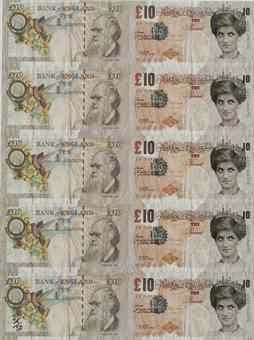 |
| Banksy Currency |
Subverting the System
By now you have heard me beat the repetitive drums of revolution over and over again. I have claimed that Jesus was engaged in subversion. Yet I have done more to explain what he didn't come to subvert and alluded to a bigger fish than Rome or any temporal power. Which system of established social order and structures of power, authority, and hierarchy did Christ come to transform? The overall system as we know it. Yet unlike Banksy's protest based on criticism of the lacks of several systems, Jesus' revolution is based on the strength of God's system. This holistic revamp of our approach to engaging life is best understood in the metaphor of a kingdom. The approach of living out the love that God has displayed in the sacrifice of His Son controls every aspect of our life. It is parallel to the way an empire (like Rome) controlled the lives of the Judeans, yet the control of God's kingdom expresses itself in the increase of freedom rather than the increase of oppression. The Kingdom of God as expressed in the love of Christ frees you from Sin and to Love. So furthering the objectives of the subversive Kingdom of God is to further the objectives of love, peace, humility, kindness and a host of other benefits for those around you. Jesus came to undermine the approach to life that builds divisions of hatred, war, selfish pride, cruelty and anything that separates God's creation from being brothers and sisters. Jesus came to subvert the system that stands in the way of the Kingdom of God.The power that Jesus subverted was pursuit of power itself, because "Blessed are the meek." The authority that Jesus came to undermine was the greed for authority itself because "You know that those who are considered rulers over the Gentiles lord it over them, and their great ones exercise authority over them. Yet it shall not be so among you; but whoever desires to become great among you shall be your servant. And whoever of you desires to be first shall be slave of all."
The hierarchy that Jesus came to dismantle was hierarchy that leads to division because "Christ Jesus, who, being in the form of God, did not consider it robbery to be equal with God, but made Himself of no reputation, taking the form of a bondservant, and coming in the likeness of men. And being found in appearance as a man, He humbled Himself and became obedient to the point of death, even the death of the cross. Therefore God also has highly exalted Him and given Him the name which is above every name, that at the name of Jesus every knee should bow, of those in heaven, and of those on earth, and of those under the earth, and that every tongue should confess that Jesus Christ is Lord, to the glory of God the Father."
That is how the King of Kings overtakes the world's kingdoms. He does it through humility, service and self sacrifice. He asked his disciples to humble themselves in service and in turn his disciples turned apostles asked their own disciples to do the same because Jesus was willing to humble himself to a death on the cross... all out of service. Jesus came to subvert our systems of power, authority and hierarchy and make us all one people. Yet he does not overthrow this system by exerting violence but rather by suffering from violence. He took the cross and nails rendered to him by sinful men so that he might take upon himself mankind's sin and render the men and women who follow him sinless. This is the upside down kingdom of God, where the King became our Servant. What shall we render to God? God asks that we give Him our lives and our sin... and our shame. In return He will subvert the power of Sin and Death and give us the eternal life of His Son.