Showing posts with label Holy Week. Show all posts

Sunday, April 20, 2014

Empty Tomb, Full Faith

ODD FELLOWS REST, TOMB WITH FERN, Sandra Russell Clark

John 20:1-9

Now on the first day of the week Mary Magdalene went to the tomb early, while it was still dark, and saw that the stone had been taken away from the tomb. Then she ran and came to Simon Peter, and to the other disciple, whom Jesus loved, and said to them, “They have taken away the Lord out of the tomb, and we do not know where they have laid Him.”
Peter therefore went out, and the other disciple, and were going to the tomb. So they both ran together, and the other disciple outran Peter and came to the tomb first. And he, stooping down and looking in, saw the linen cloths lying there; yet he did not go in. Then Simon Peter came, following him, and went into the tomb; and he saw the linen cloths lying there, and the handkerchief that had been around His head, not lying with the linen cloths, but folded together in a place by itself. Then the other disciple, who came to the tomb first, went in also; and he saw and believed. For as yet they did not know the Scripture, that He must rise again from the dead.


In her photography series Elysium Sandra Russell Clark explores the cities of the dead. The title comes from the Ancient Greeks' notion of an afterlife abode that was separate from Hades (sometimes referred to as Elysian Fields). It was a place reserved for mortals "chosen by the gods, the righteous, and the heroic." Sandra Russell Clark's Elysium refers to a place more personally familiar to me. She and I both share our birthplace in the city of New Orleans. New Orleans and Southeast Louisiana holds fast as a center of Catholicism embedded within the overall Protestant stronghold of the Deep South, while simultaneously flirting for tourists with its historic connections to the folk religion of Voodoo. It is a city that has its seasons of devout religious fervor and secular hedonism. In the midst of this city life of contrasts is set the reminder of death and the question of the afterlife: our historic cemeteries. Since New Orleans is below sea level our graves are traditionally not underground but rather above ground. Our cemeteries are ornate white wash neighborhoods for our ancestors: cities of the dead. Walking through the rows of domiciles of the departed you can chart three four centuries of our former residents form the great and notorious to the humble. The deceased are not interred into the ground but rather into tombs, like Jesus was. The scripture reading for this Easter Sunday doesn't feature Jesus. It doesn't even feature Jesus' dead body. It actually features the absence of Jesus and evidence that he  had once been in this scene: linen burial cloths and a handkerchief. It costars three followers of Jesus: Mary Magdalene, Peter and an unnamed disciple whom Jesus loved. But the star of this scene is the scene... the setting. The star is the tomb. It is an empty tomb, yet it is full. Jesus no longer resides there but one by one we encounter his followers in this scene. They too were like this tomb, empty shells that once housed death. The thing that the tomb lacked to fulfill its purpose is that which the followers of Jesus would receive. These early Christians would go on to see Jesus and after he ascended into Heaven they would later receive his Holy Spirit. Jesus would come to reside in their heart but never again in the tomb.


Death to Sin

Art is not forgiving of people's past... especially religious art. You are forever depicted in each painting or sculpture bearing a symbol of what you are most famous for. It is a tool to make the image easily identifiable for the viewer and cue their memory of the narrative surrounding them. For some it may be that of a prophet, beggar, king, soldier, martyr or virgin. For Mary Magdalene it is that of a prostitute. In most imagery she is clad in the scarlet red of harlotry. Not far from the Saint Louis Cemetery No. 1 is the are near French Quarter and Basin Street where Storyville once stood. Famous for being one of the birthplaces of Jazz, it was also New Orleans' turn of the century red light district where prostitution was legal. Just like in the case of Mary Magdalene its historic reputation has stuck. Still today much of the city's gentleman's clubs and illegal sex workers can be found there. Although society is slowly drifting towards removing the stigma associated with people who work in this industry, the physical, emotional and spiritual damage that can come to those involved in these trades still remains. All to often it is a lifestyle of sin that those who become engaged in to make ends meet become trapped in permanently by the threat of physical violence. This is the life that Mary Magdalene once knew. Prostitution was a tomb that she lived in, risking physical death from disease and spiritual death through alienation from God. Even if she knew that her life was in spiritual death, who knows if leaving it meant risking physical death by the hands of her employer? It appears to be a risk that she was willing to make. In Christ she saw life eternal and a new start at the present life. Christ had risen her from the shame of her past life and she would soon encounter him as he stood victorious having bought her eternal life. It all started because Mary Magdalene chose to leave spiritual death by putting death to sin in her life. She forsook her former life and took up the life that Christ had for her. She is an example to us all that no matter the risk deciding to follow Christ is the most life giving decision. It is an act of faith that removes spiritual death from sin and replaces it as a life of holiness. 


Death to Self

The way that you can recognize the tombs in New Orleans and learn about the life of those that are interred is by reading their tombstone. Simple enough because it is the same way the world over. The tombstone tells you the deceased name, lifespan and maybe something about their vocation, death or a revealing quote. All of these collectively reveal the person's identity but the greatest of them is the person's name. Ironically that is what is left out of the description of the first Disciple that entered Jesus' tomb. He is only revealed as "The other Disciple." Yet we do know a few things about what he did. Apparently he was a fast runner, he was a good reader of real life context clues, he had faith and Jesus loved him. The greatest part of his identity has been hidden from us... or is it? In the end what is the most important thing in life: who we are or what we do. Doesn't what we do reveal who we really are? Doesn't it reveal our character? While our surname that goes on the top of our tombstone reveals who our family was our character is a better portrait of us as an individual. There is yet another revealing detail that the author of this Gospel has left us in saying that he was the "disciple whom Jesus loved." Most scholars see this as a sign that this is referring to St. John, but it even tells us more than his identity it tells us his relationship to God. While it is good to uphold your character so that your fellow man may know who you truly are, only the virtues of faith and love can reveal who you are to God. Sure God is omniscient and knows who everyone is, but can he consider you a friend? Can he consider you his child? He can if you put to death your identity and take up the identity of Christ. That is the paradox of Christianity. You become your true self (the one that you were designed to be when you put death to the "self." That does not mean that all Christians become the same straight laced, eurocentric, 1950's cornball. Your diversity, quirks and individual gifts are needed. Don't shave off your mullet! It means that you deny your self and take your cross daily and follow Jesus. It is lining your will with the will of God and pursuing less of your whims and more of the general good of those that God has called you to serve. It is the death of selfishness and the birth of Love. It is decreasing our selves so that Christ might increase in us. It allowing space for love and action for others in our lives. It is doing unto others as you would have them do unto you. It is not just abstaining from sin against others but actively pursuing works of righteousness that would benefit others. It is an act of faith that puts to death selfish love but opens up your life to selfless love. It is what Jesus did out of love for us and it is what he loves to see in others. After all, God is Love.


Death As Service

Besides being a resting place for the dead the cemeteries of New Orleans are tourist attraction. Most things in New Orleans are a tourist attraction. After losses in the Gulf of Mexico oil industry in the early 1980's tourism took over as main engine of the economy in New Orleans. This became complicated in the early 1990's when violence started rising in the city. Just like much of the late 80's/early 90's violence in America it was mostly due to the illegal drug trade and easy access to firearms. The surge in violence spread crime to those who were unconnected to the drug trade and often normal robberies turned into murders. Things were at their worse when tourists started to be attacked while visiting the cemeteries. The sad irony was that people were killed in the area set aside to house and honor the dead. For sometime after that everyone was on guard while in cemeteries since they had now been deemed dangerous neighborhoods. Walking in the midst of this area surrounded by death made one consider his own demise. When Peter entered Christ's tom he was not considering his own mortality. He was just looking to retrieve the body of his rabbi. When Peter first encountered the risen Christ he was not considering his own mortality. He was just celebrating that Christ was risen from the grave. But then Jesus stuck around... for forty days. While Jesus was around for these forty days Peter was not considering his own mortality. Why should he? He had just experienced Jesus defeat death! But Jesus had a conversation with Peter where he asked him to consider his own mortality. He actually spelled out the way that Peter would die: he would one day be crucified. Then Jesus said that Peter's martyrdom would glorify God. Peter was a great Disciple/Apostle that was called to many great things that would give God glory. He would preach the sermon on Pentecost day that would ring thousands of souls to Christ. He would write portions of Scripture. He would perform miracles. He would act as a missionary. Tradition holds that he even founded the first church in Rome and served as its first Bishop. Even amongst all of these accolades Jesus highlights his suffering and death as his greatest service to God. Now most Christians have not and will not be called for martyrdom (that's just math). However, all Christians must be willing to make a sacrifice in their service to God. At times it may be something that you have proven weak in the past. That was the case with Peter (who had previously denied the Lord to escape danger). Yet we must remember that whatever the Lord calls us to, he will equip us for. My personal wish is that the Lord has called me to eat ice cream to his glory... but I doubt that this is the case. Whatever we discover it is the Lord is equipping us for we have faith in God that in the end His will is for the good. I imagine that Peter faced his martyrdom with courage because he knew from meeting the risen Lord that this death was not an eternal one. This death was just a doorway to eternal life. Peter chose an act of faith that put death to death and left room for eternal life.


Jesus was not from New Orleans. He could not be held in any tomb despite its Antebellum charm or no how Anne Rice-beautiful and Gothic it may be. Jesus was not a Greek nor did he share spiritual ideas with the Greeks. He was a Hebrew who worshiped the God of Israel. Yet the idea of Elysium is parallel to a notion that he preached. Yes of course their are the obvious parallels of Hades/Hell and Elysium/Heaven but I wonder if you notice another element to this analogy that may be a little more subtle. The city that Jesus focused his message on was not just a city of the dead. It was a freedom from the city of the living dead. It was a kingdom that was not just set aside for the after life but one that offered a new life for the reborn. This place that housed citizens from both the land of the living and dead is the Kingdom of God. You may know it as Heaven but the truth of it may be contrary to some of your preconceived notions. God's kingdom is not just a place for good dead people. It is more than a geographical place, it is a reality that God's children live in: be they in this part of life or the afterlife. God's kingdom is where God's reign is. It is the king's domain. It is not just a future designated time or separate space from where you are now. As Jesus put it "The Kingdom of Heaven is at hand." Or later when he said "The Kingdom of Heaven is within you." In other words the Kingdom of Heaven is here, now, within your very body. Yes the kingdom of Heaven is also where a bunch of good dead people are, if those good dead people (just like you) have received Christ. That is the key: the kingdom of Heaven is Christ. The kingdom of Heaven is the Body of Christ, which is all believers across space and time that worked out the grace, faith and mercy that they have received from God. Similar to Elysium the Kingdom of God is a gathering of  mortals chosen by God, the righteous. Our righteousness resides not in any great gift that we naturally posses but rather through the great gift of Grace that God has given us. It is subsequent gifts of mercy and love that we receive daily from this loving God that empower us to work the works of Jesus in our own age. The hope of all of the followers of Jesus that originally encountered his empty tomb that Sunday morning was that they would find Jesus. The hope of all current followers of Jesus this morning is the same. How overjoyed Mary, Peter and the unnamed disciple must have been when they encountered a living Jesus and not a dead one. How overjoyed we will be when we encounter a living faith and not a dead one. It is that faith in a living God that dwells within us through his Holy Spirit that allows us to die to sin, make sacrifices and die to self. God has cleared the death out of our mortal shells and renovated us into temples of the living God. In the end we as believers are all empty tombs full of faith displaying evidence of a risen Lord.


Friday, April 18, 2014

Holy Week- Don't Try This At Home!

Crucifixion in the Philippines, Asaf Sultan

John 15:13-15

Greater love has no one than this, than to lay down one’s life for his friends. You are My friends if you do whatever I command you. No longer do I call you servants, for a servant does not know what his master is doing; but I have called you friends, for all things that I heard from My Father I have made known to you.

With the this quote Jesus prophesied his impending Good Friday crucifixion to his disciples. Along with the other highlights of Holy Week (like Maundy Thursday and Easter Sunday) Good Friday is one of those religious holidays filled with ritual and varied historic traditions that makes you focus on the religion part of the Christian religion. In most world religions there is a delicate tension between the folk religion and the organized religion. In Christianity there is a third consideration of the pure and true religion (no, not the jeans). Sometimes true religion within one of these two camps, sometimes it mingles within both and sometimes it is neither. 


Meet Ruben Enaje. He's a fairly regular guy. He is a former construction worker who lives in Pampanga, Philippines. Currently he is a professional carpenter and sign painter but once a year (for 27 years) he abandons his normal life for a dangerous, controversial and deadly one. Every Good Friday Ruben is voluntarily crucified in a reenactment of the Crucifixion of Jesus Christ. So far he has been crucified 27 times. He does this as an act of gratitude to God for saving his life in the 80's. He is not alone Though it is discouraged by the Catholic Church leadership, several Filipino Catholics practice this folk religious rite. They do it because Jesus did it.


Church leaders are correct in discouraging this practice. It is an example of earnest people missing the point. It is the difference between what Jesus did and what Jesus asks us to do. As John 15:13-15 says, the mark of our friendship with Christ is that we do what he says/commands. Christ never asked us to be crucified for him. He laid down his life as a one time act that redeems all. He did however make several other demanding, extreme and dangerous requests of us. Jesus asked us to love our enemies, to do good for those who despitefully use us, dive headfirst into a love that promises that we will be hurt, expect suffering, to embrace as much pacifism as possible, to consider others more than ourselves, to serve without expecting reward or promotion and to expect to rise from the dead. To sum it up he asks us to embrace a lifestyle of foolish love and simple faith. His demands are the kind faith that can leave you looking foolish and extreme. Thereby St. Paul declared that "we are fools for Christ's sake." Yet throughout the ages many of Jesus' followers have tried to tame down and sanitize his call to an extreme faith. It is as if we are warning listeners "Jesus was a professional, don't try this at home."


I'm fairly sure that God doesn't co-sign on this disclaimer. True faith is dangerous, not because of its confrontational nature but because of its confrontational love. We must engage the world in love like Christ did. And frankly it's the kind if crazy notion that can get you killed. It's the type of revolutionary love that lead Jesus to lose his life. And it is the same love that empowered him to rise to new life. This love is eternal life. But if you aren't willing to taste this promise of God then maybe you shouldn't try this at home.


In his Letter from Birmingham Jail Martin Luther King, Jr. stated "So the question is not whether we will be extremist but what kind of extremist will we be. Will we be extremists for hate or will we be extremists for love?" Much like Jesus he would  later become a martyr of that extreme love that he professed. Don't worry, God has not called everyone to actually lay down their life for the cause. He has, however, called all to pick up the life of Christ. We are commissioned to cloak ourselves in the love that Christ displayed. That is how we conform to the image of Christ. It is not a matter of looking like him by physically getting on a cross. It is also not just a matter of believing like him and getting our sinful record erased. It is a matter of living like him, loving like him and acting like him to the least among us. The Christian religion is not just one to be believed in the mind and worshiped in the heart but also acted out in the outside world. Live out the truth of your faith to your family, friends and enemies. Doing this displays to the world that you not only know of God but that you also have a friendship with Him. A friendship that Jesus was willing to die for and you are willing to live for. It is true and pure religion. Even though it can be dangerous, you should forsake all prior warning and try this at home.


Wednesday, April 16, 2014

Holy Week- The Dirtiest Feet In Jerusalem, Memphis and Rome

Divine Servant, Max Greiner
Thursday many Christians around the world will celebrate Maundy Thursday. They will gather together and celebrate the Last Supper that Jesus shared with his disciples before being crucified on Good Friday. But after the supper he did something unusual that took his disciples off guard. He proceeded to wash their feet. Christians of all stripes continue this practice on the Thursday before Easter Sunday. The following are three stories about this peculiar practice amongst the faithful throughout the ages:

John 13:1-7

 
Now before the Feast of the Passover, when Jesus knew that His hour had come that He should depart from this world to the Father, having loved His own who were in the world, He loved them to the end.
And supper being ended, the devil having already put it into the heart of Judas Iscariot, Simon’s son, to betray Him, Jesus, knowing that the Father had given all things into His hands, and that He had come from God and was going to God, rose from supper and laid aside His garments, took a towel and girded Himself. After that, He poured water into a basin and began to wash the disciples’ feet, and to wipe them with the towel with which He was girded. Then He came to Simon Peter. And Peter said to Him, “Lord, are You washing my feet?”
Jesus answered and said to him, “What I am doing you do not understand now, but you will know after this.”
 

The Story Behind the Foot Washing at the 1994 “Memphis Miracle”

"Certain segments within early Pentecostalism – most prominently the Azusa Street Revival (1906-1909) in Los Angeles, California – promoted a vision of “brotherly love” across the racial divides. However, this interracial vision was quickly eclipsed as Pentecostals set out to organize churches and did so largely along cultural and racial lines. When the Pentecostal Fellowship of North America – an umbrella organization for Pentecostal denominations – was formed in 1948, its founding members were all mostly-white denominations.
Recognizing the need to heal the racial divisions within Pentecostalism, church leaders came together in Memphis on October 18, 1994 and dissolved the Pentecostal Fellowship of North America. The next day the Pentecostal and Charismatic Churches of North America (PCCNA) was formed by both white and black denominations. The meetings surrounding this monumental act of racial reconciliation came to a climax when, on October 18, a white Assemblies of God pastor, Donald Evans, approached the platform. He tearfully explained that he felt God’s leading to wash the feet of Church of God in Christ Bishop Ithiel Clemmons, while begging forgiveness for the sins of the whites against their black brothers and sisters. A wave of weeping swept over the auditorium. Participants sensed that this was the final seal of the Holy Spirit’s approval from the heart of God over the proceedings. This event, which became known as the “Memphis Miracle,” is a significant milestone in the annals of Pentecostal history..."
 

Pope washes feet of young Muslim woman prisoner in unprecedented twist on Maundy Thursday     

"While popes have for centuries washed the feet of the faithful on the day before Good Friday, never before had a pontiff washed the feet of a woman. That one of the female inmates at the prison in Rome was also a Serbian Muslim was also a break with tradition.
“There is no better way to show his service for the smallest, for the least fortunate,” said Gaetano Greco, a local chaplain.
Pope Francis washed the feet of 12 inmates aged 14 to 21, among them the two women, the second of whom was an Italian Catholic. Mr Greco said he hoped the ritual would be “a positive sign in their lives”. 
Catholic traditionalists are likely to be riled by the inclusion of women in the ceremony because of the belief that all of Jesus’ disciples were male.              
The pontiff, who has largely disregarded protocol since his election earlier this month, urged his fellow clerics before the ceremony to prioritise the poor. 
“We need to go out to the outskirts where there is suffering, bloodshed, blindness that longs for sight, and prisoners in thrall to many evil masters,” he said at a mass in St Peter’s Basilica.
“It is not in soul-searching or constant introspection that we encounter the Lord.”
Francis, the first leader of the Catholic Church from Latin America, led a mass with a mixed group of young offenders at the Casal del Marmo prison outside of Rome.
The 76-year-old, who was archbishop of Buenos Aires until chosen as pope, has already made a name for himself as a champion of the disadvantaged. In his homeland of Argentina he was known for his strong social advocacy, working in slums and shunning the lavish lifestyle adopted by some senior clerics. He lived in a small flat near the cathedral, flew to the Rome conclave in economy class, and chose to travel with his fellow cardinals by minibus rather than in the papal limousine.
Cardinal Jorge Mario Bergoglio - as Pope Francis was previously known - had already washed and kissed the feet of women in past ceremonies in Argentinian jails, hospitals and old people's homes, including pregnant mothers and AIDS patients.
Before performing the traditional feet washing, in his first general audience on Wednesday, Francis called on the world’s 1.2 billion Catholics to reach out to “lost sheep” over the coming days.
“Holy Week challenges us to step outside ourselves so as to attend to the needs of others: those who long for a sympathetic ear, those in need of comfort or help,” Francis told thousands of faithful gathered in St Peter’s Square..."
 
The strange thing about foot washing as an act of ministry is not just that it is allowing a stranger to connect with you in an intimate way but that it throws our notions of ministry for a loop. It makes us think of ministers (Christ, the Apostles, bishops, pastors, popes) as servants. Ironically that is exactly what "minister" means: servant. Wikipedia states that the English word is derived from the word "minus", denoting "less." At a time when many try to shine out and "do the most" Christ is calling us to "be the least." Christ showed us in his foot washing that we are called to serve our Christian brothers. The Assemblies of God and Church of God In Christ Pentecostals in Memphis showed us that we are called to serve our brothers that we have differences and disagreements with (racial, theological and organizational). Pope Francis showed us that we are called to serve those that we may not view as our Christian brothers and sisters because we are still all God's children. We do this because Christ call (during Easter and year-round) is one of humility, love and giving. We are called to serve the sinful, unfaithful, criminal, unrepentant, prejudiced and unfamiliar brothers and sisters that we have enmity against... because that is how Christ finds us. God sees behind the beautiful shoes that we adorn ourselves with. He knows the dirty and burdened feet that have traversed the earth running away from Him. Yet it is these feet that he reveals, embraces and washes with the water of His kindness. He kneels before us as a servant so that we might be free from the bondage of Sin. And he cleans us from our past and present, preparing our feet to walk he path of righteousness.
 
How beautiful upon the mountains
Are the feet of him who brings good news,
Who proclaims peace,
Who brings glad tidings of good things,
Who proclaims salvation,
Who says to Zion,
“Your God reigns!”


Sunday, April 13, 2014

Holy Week- New Testament Word & Image: Acts 10:34-43 & Bernardo Cavallino

St Peter and Cornelius the Centurion, Bernardo Cavallino

Acts 10:34-43

 
Then Peter opened his mouth and said: “In truth I perceive that God shows no partiality. But in every nation whoever fears Him and works righteousness is accepted by Him. The word which God sent to the children of Israel, preaching peace through Jesus Christ—He is Lord of all— that word you know, which was proclaimed throughout all Judea, and began from Galilee after the baptism which John preached: how God anointed Jesus of Nazareth with the Holy Spirit and with power, who went about doing good and healing all who were oppressed by the devil, for God was with Him. And we are witnesses of all things which He did both in the land of the Jews and in Jerusalem, whom they killed by hanging on a tree. Him God raised up on the third day, and showed Him openly, not to all the people, but to witnesses chosen before by God, even to us who ate and drank with Him after He arose from the dead. And He commanded us to preach to the people, and to testify that it is He who was ordained by God to be Judge of the living and the dead. To Him all the prophets witness that, through His name, whoever believes in Him will receive remission of sins.”

Saturday, April 12, 2014

The Word Made Flesh and the Image of the Invisible God


In the beginning of 2014 I decided that I would only create blog entries with "sermonettes" on Sundays. Most of the other entries during the week would just be the daily scripture and accompanying art images, which I call "Word & Image." I will also do this in today's blog entry. Today is Palm Sunday, which marks the beginning of Jesus' final week in Jerusalem and ends with his crucifixion and burial. It is a tradition in many churches to skip a sermon this week and read the entirety of the Passion narrative uninterrupted. While reading the following Word & Image think about it's revealing of God's Word and Image: Jesus Christ as the manifestation of God's Word in Flesh and the revelation of the image of the invisible God. If Jesus is the summation of Scripture's message and the person of God, what does that mean? Now without any further ado I present the last week in the life of Jesus Christ:  

Matthew 26:14-27:66

Judas receiving thirty pieces of silver for betraying Jesus, by Mattia Preti,
Then one of the twelve, called Judas Iscariot, went to the chief priests and said, “What are you willing to give me if I deliver Him to you?” And they counted out to him thirty pieces of silver. So from that time he sought opportunity to betray Him.
 
The Last Discourse of Christ, James Tissot
Now on the first day of the Feast of Unleavened Bread the disciples came to Jesus, saying to Him, “Where do You want us to prepare for You to eat the Passover?”
And He said, “Go into the city to a certain man, and say to him, ‘The Teacher says, “My time is at hand; I will keep the Passover at your house with My disciples.”’”
So the disciples did as Jesus had directed them; and they prepared the Passover.
When evening had come, He sat down with the twelve. Now as they were eating, He said, “Assuredly, I say to you, one of you will betray Me.”
And they were exceedingly sorrowful, and each of them began to say to Him, “Lord, is it I?”
He answered and said, “He who dipped his hand with Me in the dish will betray Me. The Son of Man indeed goes just as it is written of Him, but woe to that man by whom the Son of Man is betrayed! It would have been good for that man if he had not been born.”
Then Judas, who was betraying Him, answered and said, “Rabbi, is it I?”
He said to him, “You have said it.”
 
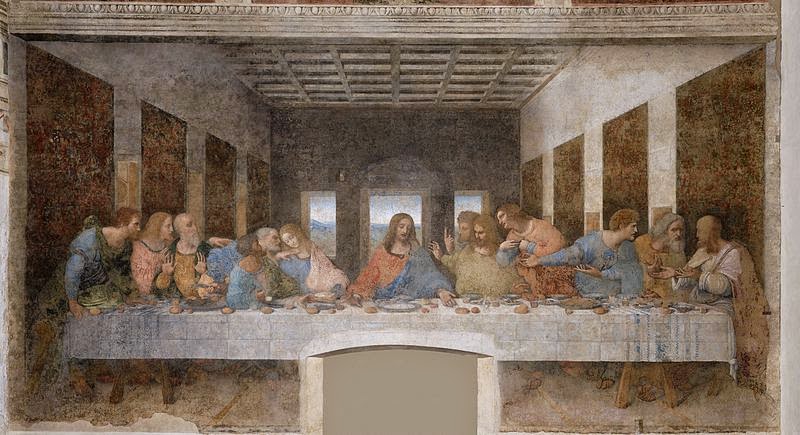
The Last Supper, Leonardo da Vinci
And as they were eating, Jesus took bread, blessed and broke it, and gave it to the disciples and said, “Take, eat; this is My body.”
Then He took the cup, and gave thanks, and gave it to them, saying, “Drink from it, all of you. For this is My blood of the new covenant, which is shed for many for the remission of sins. But I say to you, I will not drink of this fruit of the vine from now on until that day when I drink it new with you in My Father’s kingdom.”
And when they had sung a hymn, they went out to the Mount of Olives.
The Last Supper, Tintoretto
Then Jesus said to them, “All of you will be made to stumble because of Me this night, for it is written:
I will strike the Shepherd,
And the sheep of the flock will be scattered.’
But after I have been raised, I will go before you to Galilee.”
Peter answered and said to Him, “Even if all are made to stumble because of You, I will never be made to stumble.”
Jesus said to him, “Assuredly, I say to you that this night, before the rooster crows, you will deny Me three times.”
Peter said to Him, “Even if I have to die with You, I will not deny You!”
And so said all the disciples.
 
The Prayer in the Garden, Tintoretto
Then Jesus came with them to a place called Gethsemane, and said to the disciples, “Sit here while I go and pray over there.” And He took with Him Peter and the two sons of Zebedee, and He began to be sorrowful and deeply distressed. Then He said to them, “My soul is exceedingly sorrowful, even to death. Stay here and watch with Me.”
He went a little farther and fell on His face, and prayed, saying, “O My Father, if it is possible, let this cup pass from Me; nevertheless, not as I will, but as You will.”
Then He came to the disciples and found them sleeping, and said to Peter, “What! Could you not watch with Me one hour? Watch and pray, lest you enter into temptation. The spirit indeed is willing, but the flesh is weak.”
Again, a second time, He went away and prayed, saying, “O My Father, if this cup cannot pass away from Me unless[d] I drink it, Your will be done.” And He came and found them asleep again, for their eyes were heavy.
So He left them, went away again, and prayed the third time, saying the same words. Then He came to His disciples and said to them, “Are you still sleeping and resting? Behold, the hour is at hand, and the Son of Man is being betrayed into the hands of sinners. Rise, let us be going. See, My betrayer is at hand.”
 
The Taking of Christ, Caravaggio
And while He was still speaking, behold, Judas, one of the twelve, with a great multitude with swords and clubs, came from the chief priests and elders of the people.
Now His betrayer had given them a sign, saying, “Whomever I kiss, He is the One; seize Him.”  Immediately he went up to Jesus and said, “Greetings, Rabbi!” and kissed Him.
But Jesus said to him, “Friend, why have you come?”
Then they came and laid hands on Jesus and took Him. And suddenly, one of those who were with Jesus stretched out his hand and drew his sword, struck the servant of the high priest, and cut off his ear.
But Jesus said to him, “Put your sword in its place, for all who take the sword will perish by the sword. Or do you think that I cannot now pray to My Father, and He will provide Me with more than twelve legions of angels? How then could the Scriptures be fulfilled, that it must happen thus?”
In that hour Jesus said to the multitudes, “Have you come out, as against a robber, with swords and clubs to take Me? I sat daily with you, teaching in the temple, and you did not seize Me. But all this was done that the Scriptures of the prophets might be fulfilled.”
Then all the disciples forsook Him and fled.
 
Annas and Caiaphas, James Tissot
And those who had laid hold of Jesus led Him away to Caiaphas the high priest, where the scribes and the elders were assembled. But Peter followed Him at a distance to the high priest’s courtyard. And he went in and sat with the servants to see the end.
Now the chief priests, the elders, and all the council sought false testimony against Jesus to put Him to death, but found none. Even though many false witnesses came forward, they found none. But at last two false witnesses came forward and said, “This fellow said, ‘I am able to destroy the temple of God and to build it in three days.’”

Christ Before Caiaphas, Matthias Stom.
And the high priest arose and said to Him, “Do You answer nothing? What is it these men testify against You?” But Jesus kept silent. And the high priest answered and said to Him, “I put You under oath by the living God: Tell us if You are the Christ, the Son of God!”
Jesus said to him, “It is as you said. Nevertheless, I say to you, hereafter you will see the Son of Man sitting at the right hand of the Power, and coming on the clouds of heaven.”
Then the high priest tore his clothes, saying, “He has spoken blasphemy! What further need do we have of witnesses? Look, now you have heard His blasphemy! What do you think?”
They answered and said, “He is deserving of death.”
Then they spat in His face and beat Him; and others struck Him with the palms of their hands,  saying, “Prophesy to us, Christ! Who is the one who struck You?”
 
The Denial of Saint Peter, Caravaggio
Now Peter sat outside in the courtyard. And a servant girl came to him, saying, “You also were with Jesus of Galilee.”
But he denied it before them all, saying, “I do not know what you are saying.”
And when he had gone out to the gateway, another girl saw him and said to those who were there, “This fellow also was with Jesus of Nazareth.”
But again he denied with an oath, “I do not know the Man!”
And a little later those who stood by came up and said to Peter, “Surely you also are one of them, for your speech betrays you.”
Then he began to curse and swear, saying, “I do not know the Man!”
Immediately a rooster crowed. And Peter remembered the word of Jesus who had said to him, “Before the rooster crows, you will deny Me three times.” So he went out and wept bitterly.
When morning came, all the chief priests and elders of the people plotted against Jesus to put Him to death. And when they had bound Him, they led Him away and delivered Him to Pontius Pilate the governor.
 
Judas Hangs Himself, James Tissot
Then Judas, His betrayer, seeing that He had been condemned, was remorseful and brought back the thirty pieces of silver to the chief priests and elders, saying, “I have sinned by betraying innocent blood.”
And they said, “What is that to us? You see to it!”
Then he threw down the pieces of silver in the temple and departed, and went and hanged himself.
But the chief priests took the silver pieces and said, “It is not lawful to put them into the treasury, because they are the price of blood.” And they consulted together and bought with them the potter’s field, to bury strangers in. Therefore that field has been called the Field of Blood to this day.
Then was fulfilled what was spoken by Jeremiah the prophet, saying, “And they took the thirty pieces of silver, the value of Him who was priced, whom they of the children of Israel priced,  and gave them for the potter’s field, as the Lord directed me.”
 
Christ before Pilate, Mihály Munkácsy,
Now Jesus stood before the governor. And the governor asked Him, saying, “Are You the King of the Jews?”
Jesus said to him, “It is as you say.” And while He was being accused by the chief priests and elders, He answered nothing.
Then Pilate said to Him, “Do You not hear how many things they testify against You?” But He answered him not one word, so that the governor marveled greatly.
 
Ecce Homo ("Behold The Man"), Caravaggio
Now at the feast the governor was accustomed to releasing to the multitude one prisoner whom they wished. And at that time they had a notorious prisoner called Barabbas. Therefore, when they had gathered together, Pilate said to them, “Whom do you want me to release to you? Barabbas, or Jesus who is called Christ?” For he knew that they had handed Him over because of envy.
While he was sitting on the judgment seat, his wife sent to him, saying, “Have nothing to do with that just Man, for I have suffered many things today in a dream because of Him.”
 
Ecce Homo (Behold The Man"), Antonio Ciseri
But the chief priests and elders persuaded the multitudes that they should ask for Barabbas and destroy Jesus. The governor answered and said to them, “Which of the two do you want me to release to you?”
They said, “Barabbas!”
Pilate said to them, “What then shall I do with Jesus who is called Christ?”
They all said to him, “Let Him be crucified!”
Then the governor said, “Why, what evil has He done?”
But they cried out all the more, saying, “Let Him be crucified!”
When Pilate saw that he could not prevail at all, but rather that a tumult was rising, he took water and washed his hands before the multitude, saying, “I am innocent of the blood of this just Person. You see to it.”
And all the people answered and said, “His blood be on us and on our children.”
Then he released Barabbas to them; and when he had scourged Jesus, he delivered Him to be crucified.
 
Christ at the Column (The Flagellation), Caravaggio
Then the soldiers of the governor took Jesus into the Praetorium and gathered the whole garrison around Him. And they stripped Him and put a scarlet robe on Him. When they had twisted a crown of thorns, they put it on His head, and a reed in His right hand. And they bowed the knee before Him and mocked Him, saying, “Hail, King of the Jews!” Then they spat on Him, and took the reed and struck Him on the head. And when they had mocked Him, they took the robe off Him, put His own clothes on Him, and led Him away to be crucified.
 
Christ Crowned with Thorns, Matthias Stom
Now as they came out, they found a man of Cyrene, Simon by name. Him they compelled to bear His cross. And when they had come to a place called Golgotha, that is to say, Place of a Skull, they gave Him sour wine mingled with gall to drink. But when He had tasted it, He would not drink.
Then they crucified Him, and divided His garments, casting lots, that it might be fulfilled which was spoken by the prophet:
“They divided My garments among them,
And for My clothing they cast lots.”
Sitting down, they kept watch over Him there. And they put up over His head the accusation written against Him:
THIS IS JESUS THE KING OF THE JEWS.
 
Calvary, Andrea Mantegna
Then two robbers were crucified with Him, one on the right and another on the left.
And those who passed by blasphemed Him, wagging their heads and saying, “You who destroy the temple and build it in three days, save Yourself! If You are the Son of God, come down from the cross.”
 Likewise the chief priests also, mocking with the scribes and elders, said,  “He saved others; Himself He cannot save. If He is the King of Israel, let Him now come down from the cross, and we will believe Him. He trusted in God; let Him deliver Him now if He will have Him; for He said, ‘I am the Son of God.’”
Even the robbers who were crucified with Him reviled Him with the same thing.
 
Abstract Painting No. 5 1962, Ad Reinhardt
Now from the sixth hour until the ninth hour there was darkness over all the land. And about the ninth hour Jesus cried out with a loud voice, saying, “Eli, Eli, lama sabachthani?” that is, “My God, My God, why have You forsaken Me?”
Some of those who stood there, when they heard that, said, “This Man is calling for Elijah!”  Immediately one of them ran and took a sponge, filled it with sour wine and put it on a reed, and offered it to Him to drink.
The rest said, “Let Him alone; let us see if Elijah will come to save Him.”
And Jesus cried out again with a loud voice, and yielded up His spirit.
Then, behold, the veil of the temple was torn in two from top to bottom; and the earth quaked, and the rocks were split, and the graves were opened; and many bodies of the saints who had fallen asleep were raised; and coming out of the graves after His resurrection, they went into the holy city and appeared to many.
 
Crucifixion, seen from the Cross, James Tissot
So when the centurion and those with him, who were guarding Jesus, saw the earthquake and the things that had happened, they feared greatly, saying, “Truly this was the Son of God!”
And many women who followed Jesus from Galilee, ministering to Him, were there looking on from afar, among whom were Mary Magdalene, Mary the mother of James and Joses, and the mother of Zebedee’s sons.
 
The Entombment of Christ, Caravaggio
Now when evening had come, there came a rich man from Arimathea, named Joseph, who himself had also become a disciple of Jesus. This man went to Pilate and asked for the body of Jesus. Then Pilate commanded the body to be given to him.
 
The Transport of Christ to the Sepulcher, Antonio Ciseri
When Joseph had taken the body, he wrapped it in a clean linen cloth, and laid it in his new tomb which he had hewn out of the rock; and he rolled a large stone against the door of the tomb, and departed. And Mary Magdalene was there, and the other Mary, sitting opposite the tomb.
 
The Dead Christ Lying on His Shroud, Philippe de Champaigne
On the next day, which followed the Day of Preparation, the chief priests and Pharisees gathered together to Pilate, saying, “Sir, we remember, while He was still alive, how that deceiver said, ‘After three days I will rise.’ Therefore command that the tomb be made secure until the third day, lest His disciples come by night and steal Him away, and say to the people, ‘He has risen from the dead.’ So the last deception will be worse than the first.”
Pilate said to them, “You have a guard; go your way, make it as secure as you know how.” So they went and made the tomb secure, sealing the stone and setting the guard.